About the Department
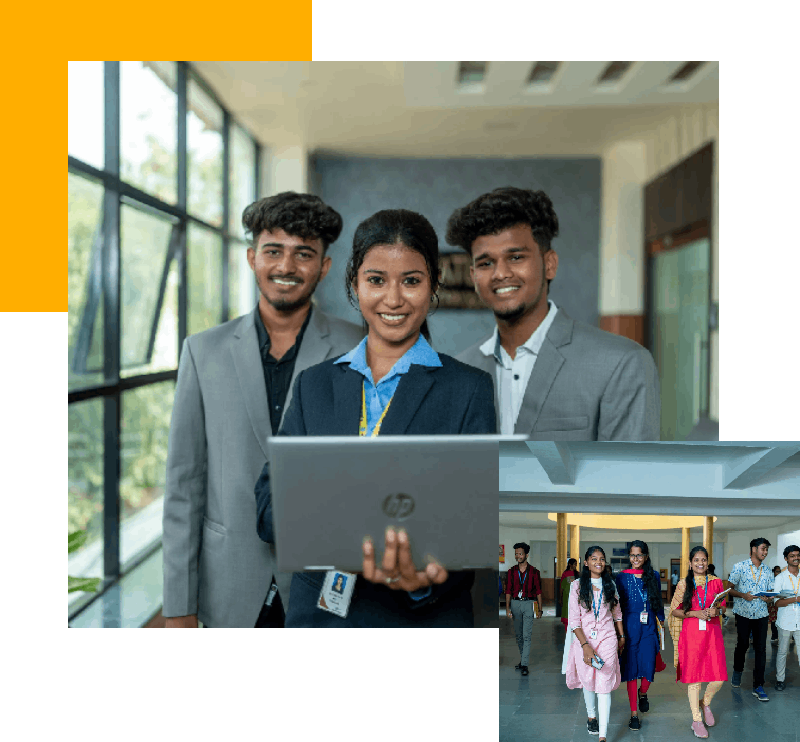
The CSE department was started in the year 2008 with a focus on advancing students knowledge and technology in the field of computing. Today the department emphazises on fostering innovation, research, and excellence in computing science and engineering domain. It is also dedicated to empowering students to become skilled engineers, researchers and leaders in futuristic technological landscape such as artificial intelligence, machine learning, data science etc.,
The department offers a dynamic learning environment supported by experienced faculty, modern laboratories, and industry-oriented curriculum. The department is powered by a practical approach that allows the teacher and a group of students to shape the learning styles based on the
learners’ profile and create an atmosphere that promotes constructivism and collaboration. Additionally, practical and project based learning approach infused in the curriculum, helps in building a strong foundation of knowledge among students. They are encouraged to participate in research projects, internships, and collaborations with faculty and industry partners. Through a balance of theoretical foundations and hands-on practice, students gain the technical expertise and problem-solving skills needed to address real-world challenges.
The CSE department focuses on emerging areas such as Artificial Intelligence, Machine Learning, Cybersecurity, Cloud Computing and Data science.
Information for CSE aspirants
Computer Science Engineering (CSE) covers a wide range of subjects including programming languages such as C, Java, Python, R-programming, core courses such as operating systems, database design, compiler design, verticals such as networking, algorithms, data science, machine learning etc,. Industry 4.0 relies on automation and data exchange in manufacturing technologies and processes. Which includes, Internet of Things (IoT), Artificial Intelligence, Cloud Computing, Cyber-Physical Systems (CPS), Cyber Security, Cognitive Computing, and Industrial Internet of Things (IIOT). The aim of Industry 4.0 is to explore and capitalise on the enormous potential of emerging technologies such as robotics, Virtualization and Digital Transformation (DX) of business processes across industry.

Why CSE @ KCE?
- Established in 2008 it offers B.E (CSE) ,B.E(CSE-AI&ML) and M.E (CSE)
- AI driven technology platform for TLP
- Highly qualified faculty members
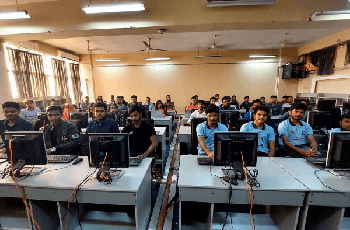
- State of art laboratory facilities
- Industry collaborated R&D Labs
- Many technical Clubs such as Software development club, Coding Club.
- GATE focused training
- Project based learning , Experiential learning- Project & Internship / mentoring students
- Personality development programs through social/clubs
- Intensive training programs for placements
Benefits
- Hands on Project Experience.
- Cyber Security – Hands on Skill Training
- Placement in product based companies
- Placement in Service based companies
- Opportunities in Government Sector
Vision
To empower students with the latest skills in the ever-changing field of Computer Science & Engineering supplemented with practical orientation to meet the growing needs of the modern computing industry and society.
Mission
- To achieve academic excellence by providing fundamental concepts and advanced technologies in the field of Computer Science and Engineering.

- Motivate the students to update with the latest computer technologies to succeed in the ever-changing world.
- To provide holistic education to practice profession ethically with leadership quality.
Program Educational Objectives(PEOs)
PEO1: The graduates shall exhibit exemplary knowledge in engineering to analyze and solve problems in the field of computer science and engineering.
PEO2: The graduates shall demonstrate the skills to adapt the emerging Technological changes.
PEO3: The graduates shall be professionally competent in contributing to the society.
Programme Outcomes (POs)
- Engineering knowledge: Apply the knowledge of mathematics, science, engineering fundamentals, and an engineering specialization to the solution of complex engineering problems.
- Problem analysis: Identify, formulate, research literature, and analyze complex engineering problems reaching substantiated conclusions using first principles of mathematics, natural sciences, and engineering sciences.
- Design/development of solutions: Design solutions for complex engineering problems and design system components or processes that meet the specified needs with appropriate consideration for the public health and safety, and the cultural, societal, and environmental considerations.
- Conduct investigations of complex problems: Use research-based knowledge and research methods including design of experiments, analysis and interpretation of data, and synthesis of the information to provide valid conclusions.
- Modern tool usage: Create, select, and apply appropriate techniques, resources, and modern engineering and IT tools including prediction and modelling to complex engineering activities with an understanding of the limitations.
- The engineer and society: Apply reasoning informed by the contextual knowledge to assess societal, health, safety, legal, and cultural issues and the consequent responsibilities relevant to the professional engineering practice.
- Environment and sustainability: understand the impact of the professional engineering solutions in societal and environmental contexts, demonstrate the knowledge of, and need for sustainable development.
- Ethics: Apply ethical principles and commit to professional ethics, responsibilities, and norms of the engineering practice.
- Individual and teamwork: Function effectively as an individual, and as a member or leader in diverse teams, and in multidisciplinary settings.
- Communication: Communicate effectively on complex engineering activities with the 21 engineering community and with society at large, such as, being able to comprehend and write effective reports and design documentation, make effective presentations, and give and receive clear instructions.
- Project management and finance: Demonstrate knowledge and understanding of the engineering and management principles and apply these to one’s own work, as a member and leader in a team, to manage projects and in multidisciplinary environments.
- Life-long learning: Recognize the need for, and have the preparation and ability to engage in independent and life-long learning in the broadest context of technological change.
Program Specific Outcome (PSOs)
Graduates should be able to
PSO 1: Design data structures and database management systems with a recurrent programming language to provide software solutions.
PSO 2: Develop algorithms for problem solving in the fields of Artificial Intelligence, Big Data and Cloud Computing.
Faculty Details
| Name of Faculty | Designation | Area of Expertise |
|---|---|---|
| Dr.SJK. Jagadeeshkumar | Professor & Head | Artificial Intelligence, Deep Learning and Broadband Wireless Networks |
| Dr.C.Vimalarani | Professor | Artificial Neural Networks and Image Processing |
| Dr.D.Jayasutha | Asso. Prof. | Cloud Computing |
| Dr.M.Sukanya | Asso. Prof. | Networks |
| Mrs.K.Kanchana | Asst. Prof. | Data Science and Data Analytics |
| Mrs.S.Aarthi | Asst. Prof. | Wireless Networks |
| Mrs.T.S.Usha Nandhini | Asst. Prof. | Artificial Intelligence and Machine Learning |
| Mrs. N. Rajasankari | Asst. Prof. | Automata Theory |
| Mr.D.Ravi | Asst. Prof. | Networks |
| Mrs.S.Dhivyabharathi | Asst. Prof. | Network Security |
| Mrs.S.P.Vidhyapriya | Asst. Prof. | Computer Networks |
| Mrs.S.Vijayalakshmi | Asst. Prof. | Automata Theory, Computational Theory, Compiler Design |
| Mrs. D. Kanimozhi | Asst. Prof. | Networks and Network Security |
Highlights of the Department
- AI driven technology E-Box platform for TLP
- Highly qualified faculty members
- Industry collaborated R&D Labs
- Many technical Clubs such as Software development club, Coding Club.
Lab Facilities
Networks Lab
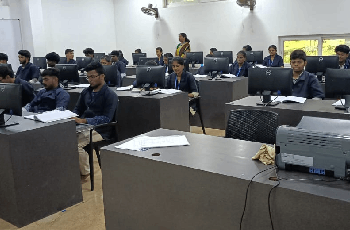
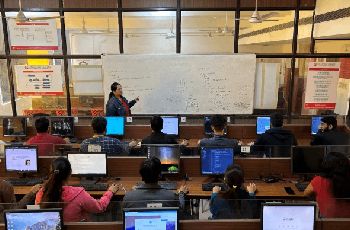
Networks and simulation Lab consists of state of art infrastructure with high end configuration computing equipment supported by high speed Ethernet and wireless networks. This lab is provided with high speed internet connectivity round the clock. This lab is equipped with a wide variety of proprietary and open source software for experimenting real world concepts in networking. Some of the software includes NS2, Packet Tracer, NetStumbler, etc with the help of which the students can build their own network, know how data communication takes place in real world and so on.
DBMS LAB
The DBMS Lab provides hands-on experience in designing and managing databases. It helps students understand relational models, create tables, apply constraints, and perform operations using SQL commands. Through practical experiments like queries, joins, views, PL/SQL programs, and triggers, students learn how to store, retrieve, and manage data efficiently. The lab strengthens problem-solving skills and prepares students to work with real-world database applications.
Cloud Computing Lab
The Cloud Computing Lab enables students to understand and work with cloud platforms and services. It provides hands-on experience in deploying applications, managing virtual machines, configuring cloud storage, and using service models like IaaS, PaaS, and SaaS. Through practical exercises, students learn how to build scalable, flexible, and cost-efficient cloud solutions, preparing them for real-world cloud environments.
Programming and Data Structures Lab
The Programming and Data Structures Lab helps students develop strong problem-solving skills by writing and executing programs using fundamental data structures. It provides hands-on practice using arrays, stacks, queues, linked lists, trees, graphs, and sorting and searching techniques. Through coding exercises and algorithm implementation, students learn how to organize data efficiently and build optimized solutions for real-time applications.
Mobile Application Development Laboratory
Mobile app means a lot to us. In mobile application laboratory, students are actively engaged in developing various applications for Android mobile phones with the help of Android studio, Kotlin etc. Brilliant Bird Technologies, Coimbatore have signed an MOU, to train the students to develop various mobile apps. Students have participated in many events and won prizes in mobile application development.
Faculty Publications
| Name of Faculty | Designation | Title | Name of the Journal/Volume/Issue/PP |
|---|---|---|---|
| Dr.S.J.K. Jagadeesh Kumar | Professor and Head | A Combined Credit Risk and Collaborative Watchdog Method for Detecting SelfishNode over Mobile AdHoc Network | International Journal of Advanced Research in Computer Science and Software, 2012 |
| An Enhanced scheduling algorithm for QoS optimization in 802.11 e based Networks | Global Journal of Computer Science and Technology 12 (5), 2012 | ||
| An Enhanced QoS Provisioning Approach for Video Streams using Cross Layer Design in IEEE 802.16 | Global Journal of Computer Science and Technology 12 (11E), 2012 | ||
| A Forced Caching Scheme to Improve Data Access in Disruption Tolerant Networks | First International Conference on Computational Intelligence and Informatics, Advances in Intelligent Systems and Computing 507, DOI 10.1007/978-981-10-2471-9_26, 2017 | ||
| Improving the Performance of Mobile Ad Hoc Network using a Combined Credit Risk and Collaborative Watchdog Method | Global Journals Inc.(US) 13 (6),2013 |
Association with reputed companies / industries
- Avatar Academy
- Zengage Technologies
- Effitrac Solutions India Private Ltd
- A2B2 IT Services
- Globas smart Technologies
- Toon Explainers
- Sylix Pro technologies
- iExemplar Software India Private Ltd
Offers Value Added Programs and certification courses
- Cyber security
- Programming in Python
- Programming in C
- React JS
- Programming in java
- Angular JS
Associated with various professional bodies
- Indian Society for Technical Education (ISTE)
- Computer Society of India (CSI)
- National Council for Social Studies (NCSS)
HOD’S Message
The Department of Computer Science & Engineering (CSE) is committed to provide a community of learners, innovators and future leaders who can excel in this dynamically changing field. The department offers an industry oriented curriculum that combines theoretical foundations with practical applications in the emerging areas such as Artificial Intelligence, Cyber security, Data analytics etc., The department has a team of highly experienced and motivated faculty members who are in the process of tuning the young minds to make them globally competitive. Department of Computer Engineering endeavors to provide best professional opportunities to our students and look forward to their bright future.